AI and learning
Experience, Reflection, and Learning in the Age of AI
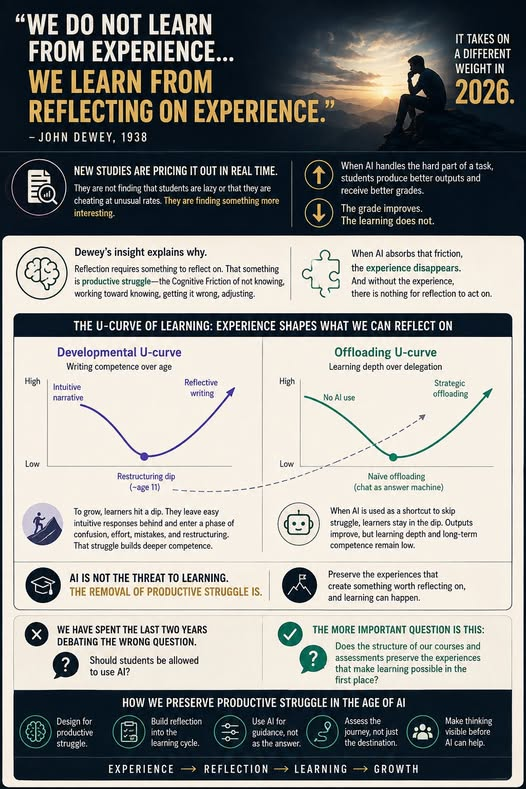
“We do not learn from experience. We learn from reflecting on experience.”
John Dewey wrote that in 1938. It takes on a different weight in 2026.
After years working in EdTech, and now spending most of my time directly in the weeds of building AI products for higher education, I was struck by the quote and this idea really resonated with me. I see the tension almost every day. We can make the technology faster, remove friction, automate more of the work, and produce a better output. But in education, a better output is not always the same thing as a better outcome.
The research is starting to put numbers behind this distinction. Studies are not simply finding that students are lazy or cheating at unusual rates. They are finding something more interesting. When AI handles the hard part of a task, students can produce better outputs while retaining less knowledge. The grade can improve while the learning does not.
The role of cognitive friction
Dewey's insight explains why. Reflection requires something to reflect on. That something is cognitive friction, the productive struggle of not knowing, working toward knowing, getting it wrong, adjusting, and eventually figuring it out. When AI absorbs too much of that friction, the experience disappears. Without the experience, there is less for reflection to act on.
This is where my experience building AI for education has changed my own thinking. Early on, the obvious product question was how much AI we should give the student. Now I think that question is incomplete. The harder and much more important product decision is figuring out where AI should help and where it needs to get out of the way.
Ask the more important question
We have spent the last few years debating whether students should be allowed to use AI. After years working in EdTech, and especially after working directly on this problem, I think that is the wrong debate. The more important question is whether the structure of our courses, assessments, and AI tools preserves the experiences that make learning possible in the first place.
AI is not the threat to learning. The removal of productive struggle is.